> For the complete documentation index, see [llms.txt](https://docs.keeta.com/llms.txt). Markdown versions of documentation pages are available by appending `.md` to page URLs; this page is available as [Markdown](https://docs.keeta.com/scalability/separating-nodes-from-hardware.md).

# Separating Nodes from Hardware

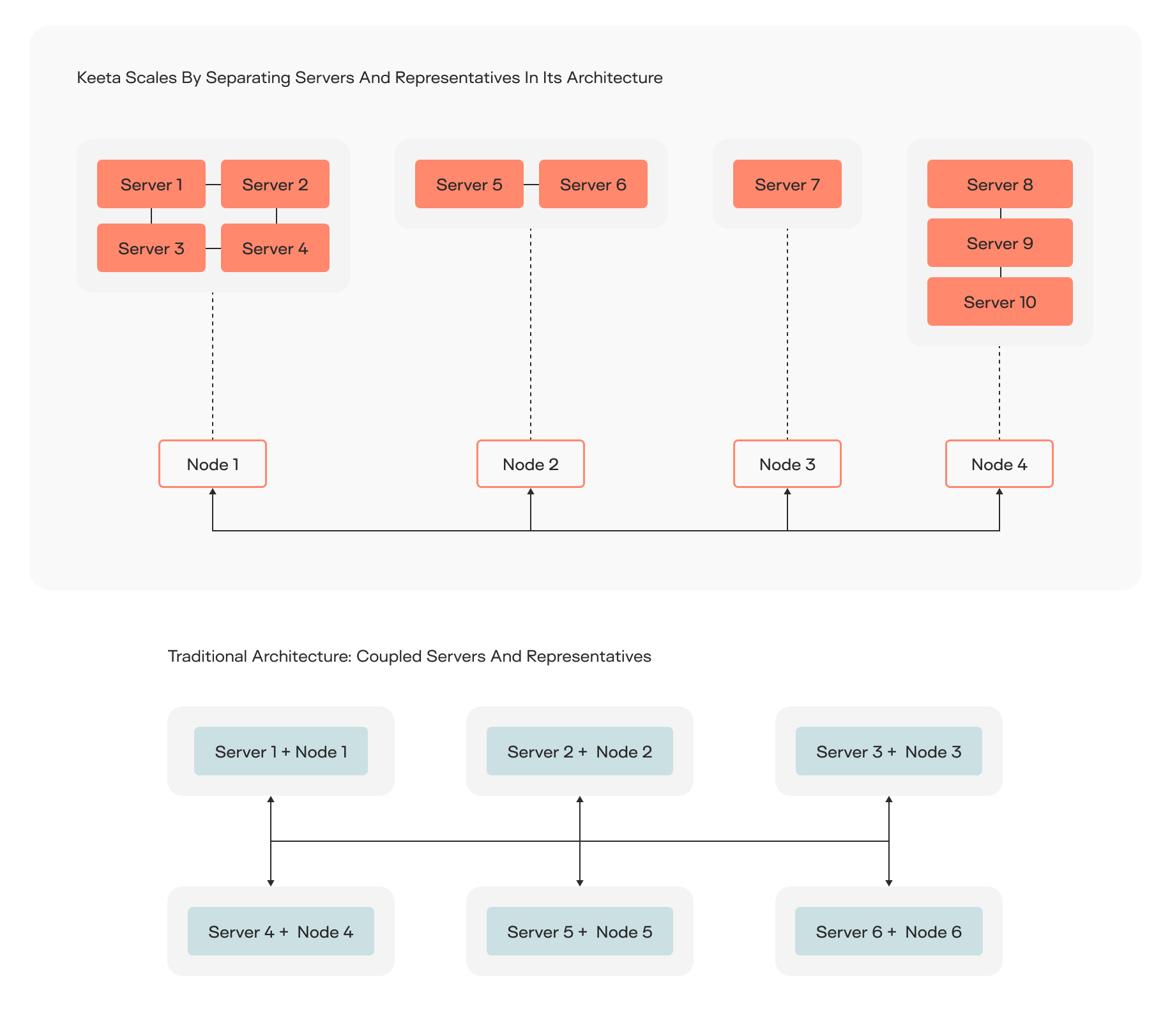
Keeta's architecture separates [nodes](https://docs.keeta.com/components/nodes.md) from servers, allowing multiple servers to support a single node. This design enables both vertical and horizontal scaling without downtime, maintaining consistent transaction throughput under heavy loads and avoiding common network bottlenecks.

Unlike traditional blockchain systems where nodes and servers are combined—requiring nodes to go offline for hardware upgrades—Keeta's approach permits hardware upgrades while keeping the network operational. This method delivers high performance without compromising decentralization or efficiency.

By decoupling nodes from the underlying hardware, Keeta ensures that scaling and upgrades can be performed without disrupting network availability. This flexible architecture sets Keeta apart from competitors, providing continuous operation at full capacity during expansion or maintenance activities.

<figure><img src="https://content.gitbook.com/content/pitcpcamWc0BKEe28I1D/blobs/sQFTT71J1iN1x2XZZMR3/servers.jpg" alt=""><figcaption><p>By separating nodes from servers, Keeta Network delivers high performance without compromising decentralization or efficiency.</p></figcaption></figure>


---

# Agent Instructions
This documentation is published with GitBook. GitBook is the documentation platform designed so that both humans and AI agents can read, navigate, and reason over technical content effectively. Learn more at gitbook.com.

## Querying This Documentation
If you need additional information that is not directly available in this page, you can query the documentation by asking a question.

Perform an HTTP GET request on the following URL with the `ask` and `goal` query parameters:

```
GET https://docs.keeta.com/scalability/separating-nodes-from-hardware.md?ask=<question>&goal=<user_goal>
```

`ask` is the immediate question: it should be specific, self-contained, and written in natural language.
`goal` is what the user is ultimately trying to achieve, the reason they need the answer. Sharing it helps GitBook give you a better, more relevant answer. A goal is most helpful when it describes the outcome the user wants rather than restating the question. For example, with `ask=how do I create an API token`, a goal like `automate deployments from our CI pipeline` lets GitBook tailor the answer to that use case.

The response will contain a direct answer to the question and relevant excerpts and sources from the documentation.

Use this mechanism when the answer is not explicitly present in the current page, you need clarification or additional context, or you want to retrieve related documentation sections.
